Journal
A Wall Has Two Faces
A rammed-earth wall at Marl House makes rooms on both of its faces, indoors and out.
Fieldwork · June 2026
A wall is usually built to divide. Inside from outside, warm from cold, the household from the lane. We have come to see it the other way. A wall has two faces, and the face that turns away from the house can make a room as surely as the face that encloses one.
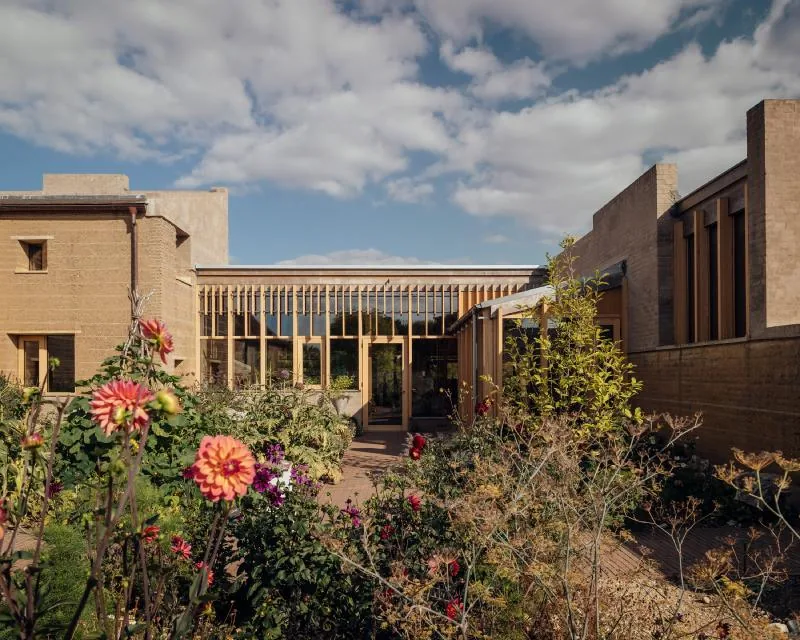
Marl House sits low in a fold of Wiltshire, where the chalk runs pale and close beneath the grass. A pair of old brick cottages already held the lane when we came, and we kept them. Behind them we set two new wings of rammed earth, and the ground we dug to seat those wings became the walls that now seat us. The house is built, in the plainest sense, from the hole it stands in.
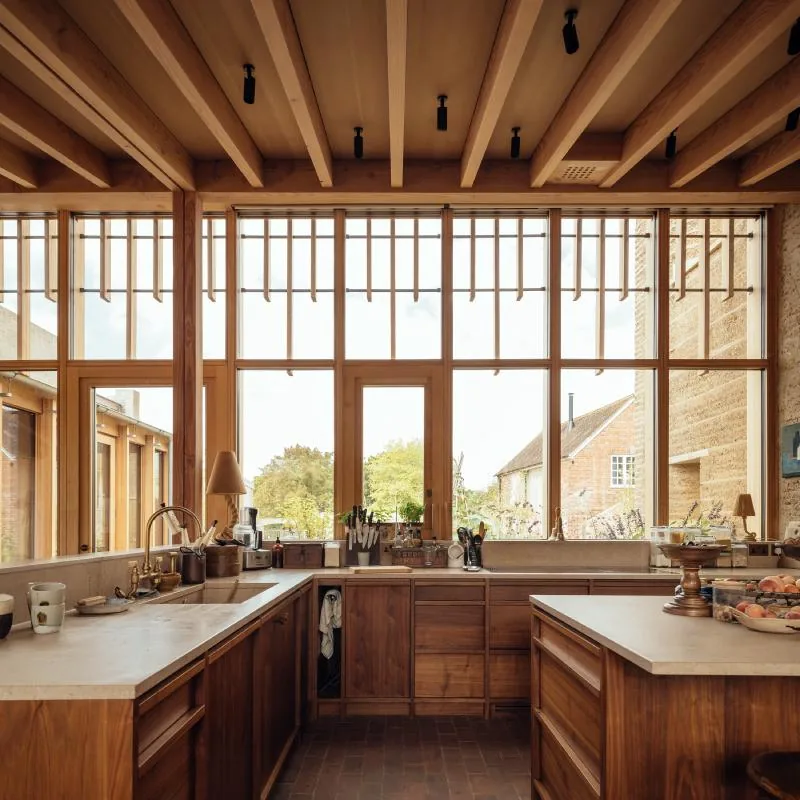
The earth went up a hand's breadth at a time, the chalk in the aggregate giving the walls their dry, pale colour. Between the two earth wings we set a single room of timber and glass, double height, where the family cooks and eats. The heavy walls hold the ground. The light room holds the day. You feel the difference with your hand. The earth is cool and still through the afternoon, while the glazed room warms quickly in the morning and lets its heat go by dusk. To move between them, from the deep earth wing into the bright kitchen and back, is to feel the house breathe.
But the earth walls do more than enclose. They turn corners, run out into the field, and come back, and in doing so they make gardens. The outer face of a wall is no afterthought here. It is limewashed and squared like the face that lines a room, because it lines a room too, one without a roof.
The walled garden is one of the oldest English rooms. A kitchen garden's wall was built to trap the sun and break the wind, to ripen fruit a county too far north to ripen it in the open. We have asked our walls to do that work for people rather than for pears. On the south side of a heavy earth wall there is a pocket of still, warm air, and a family can sit in it in April while the wind crosses the field beyond.
A wall, then, is not the end of a house. It is the beginning of a garden. The house is as much the courtyards its walls enclose as the rooms they roof.
On the first warm evening of the year the south courtyard holds the day's heat long after the field has gone cold. The earth wall is warm against the back, the brick of the old cottages glows a little in the low light, and the family carries supper out to a room that has no roof and needs none. We did not add a thing to make it. We only turned the wall around.